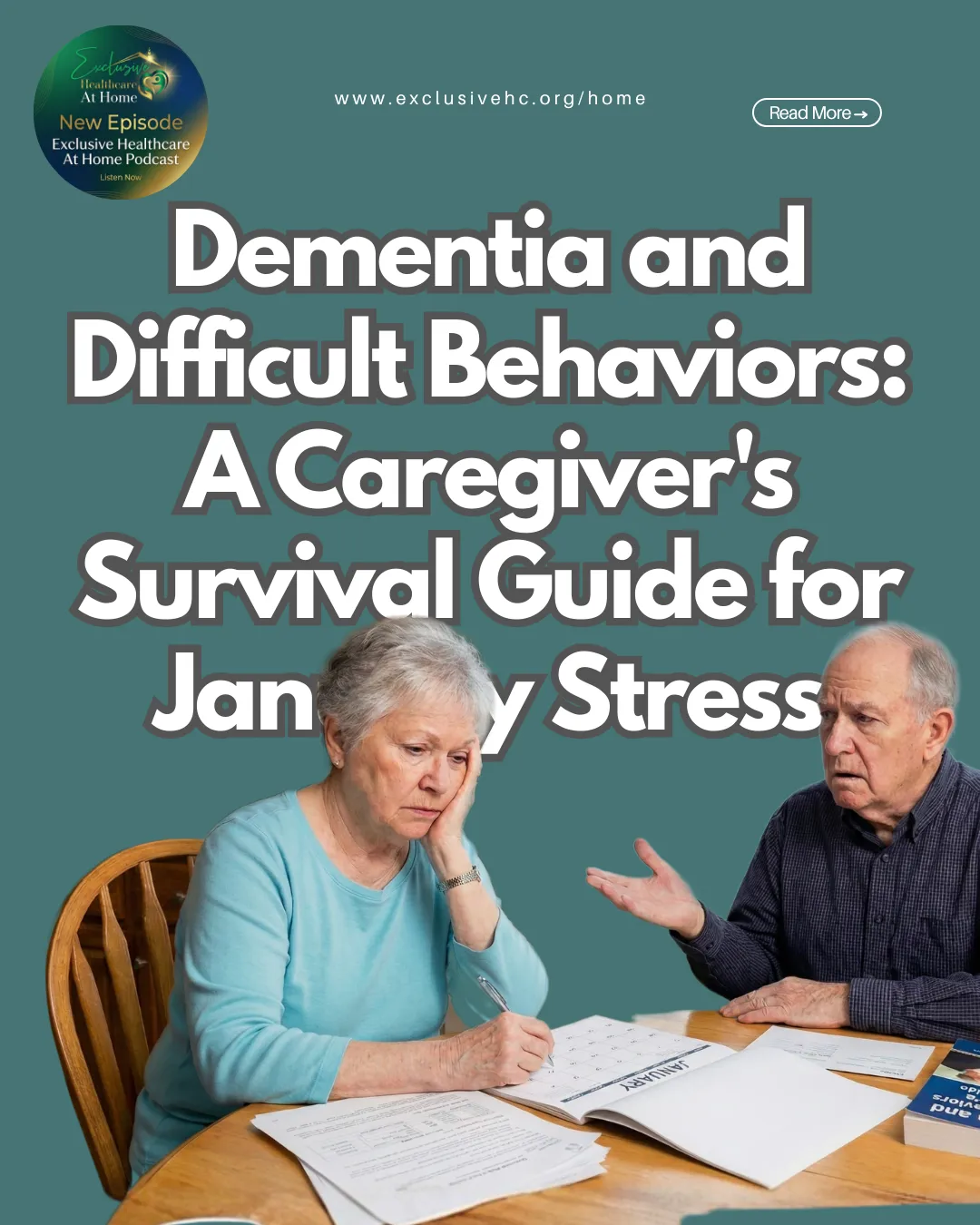
Dementia and Difficult Behaviors: A Caregiver’s Survival Guide for January Stress

Dementia and Difficult Behaviors: A Caregiver's Survival Guide for January Stress
You made it through the holidays. The relatives have gone home. The house is quiet again. But something feels… off.
Maybe it was the way your mom didn't recognize your cousin at Christmas dinner. Or how your dad became agitated when too many people crowded into the kitchen. Perhaps it's the withdrawal you're seeing now—the confusion that seems worse than it was in November.
You're not imagining it. And you're not alone.
January is one of the hardest months for families caring for someone with dementia. The post-holiday comedown, combined with the disruption to routine and the stark reality of changes you may have been able to ignore before, creates a perfect storm of stress for both caregivers and those living with cognitive decline.
If you're in the Upstate and feeling overwhelmed right now, this guide is for you.
What's Really Happening: Post-Holiday Behavioral Shifts
The holidays throw everything off balance. For someone with dementia, this disruption can trigger behaviors that seem to come out of nowhere:
Increased confusion and disorientation – All those visitors, the changed meal times, the different decorations – these disruptions to routine can cause significant cognitive stress. What looks like "sudden decline" may actually be an acute reaction to environmental chaos.
Agitation and irritability – Dementia specialist Teepa Snow, whose Positive Approach to Care has revolutionized how we understand difficult behaviors, reminds us that what we label as "agitation" is often a person's best attempt to communicate an unmet need. They're not trying to be difficult – they're struggling to tell us something's wrong.
Withdrawal and depression – January's gray skies don't help, but there's often something deeper happening. The person you're caring for may sense they "failed" at the holidays – couldn't remember names, couldn't follow conversations. The shame and frustration can lead to pulling back from activities they previously enjoyed.
Sundowning that seems worse – Shorter days mean earlier darkness, and for many people with dementia, late afternoon and evening become particularly challenging. If you're noticing increased restlessness, pacing, or confusion as the sun sets, you're observing a real phenomenon that affects up to 20% of people with Alzheimer's disease.
The Hand-Under-Hand Revolution: Teepa Snow's Game-Changing Technique
Here's what most well-meaning caregivers do wrong: they approach from the front, grab the person's hand, and try to lead them through a task. This triggers a startle response and often resistance.
Teepa Snow's hand-under-hand approach flips this entirely:
The technique:
Approach from the side, where they can see you without feeling confronted
Slide your hand under theirs, palm up
Let their hand rest on top of yours – they're in control
Guide gently from underneath, supporting rather than directing
Why it works: This approach preserves dignity and agency. You're not taking over – you're providing support while they maintain the lead. It's the difference between being helped and being helpless.
Try this during challenging moments: bathing, dressing, eating. The change in response can be remarkable.
Environmental Triggers You Might Be Missing
Nancy Mace and Peter Rabins authors of The 36-Hour Day (the caregiving bible that's been helping families since 1981), emphasize that behavior is communication. When someone with dementia becomes difficult, they're telling you something in their environment isn't working.
Common January culprits in Upstate homes:
Temperature confusion – Our Greenville winters may be mild compared to up North, but the swing from 60 degrees one day to 30 the next confuses everyone. People with dementia often have impaired ability to sense temperature. They may be cold but can't articulate it, leading to agitation.
Lighting issues – January's early darkness combined with insufficient indoor lighting creates shadows, reflections, and visual confusion. That mirror in the hallway? It might look like a stranger. The TV reflection in the window at dusk? Potentially frightening.
Noise and chaos hangover – Even though the holidays are over, the sensory overload effects linger. The brain needs time to recalibrate. Keeping things calm and predictable for the next few weeks isn't coddling – it's smart recovery strategy.
Routine disruption – If you're trying to "get back to normal" but the routine has changed (different meal times, different helpers, different daily structure), you're actually creating ongoing instability.
Validation: The Most Powerful Tool You're Probably Not Using
Here's a scenario: Your mother insists she needs to pick up the kids from school. The kids are 45 years old.
What most people do: "Mom, the kids are grown. You don't need to pick anyone up."
What this creates: Confusion, argument, sometimes escalation. You've told her she's wrong about her reality, which is frustrating and frightening.
Validation approach: "You're thinking about the kids. You always made sure they got home safely. Tell me about picking them up from school – which school did they go to?"
You're not lying. You're entering her reality and honoring the emotion underneath the confusion. The need she's expressing – to care for her children, to be needed, to fulfill her role – is real, even if the timeframe isn't.
This is straight from Teepa Snow's playbook, and it transforms interactions.
When to Involve Professional Care (And Why It's Not Giving Up)
There's a dangerous myth in the South: that putting your parent in care or bringing in outside help means you've failed.
Let's be clear: This is nonsense.
Professional support is a tool, not a surrender. Consider reaching out when:
You're regularly losing your temper
The person you're caring for is at risk (wandering, falling, medication errors)
Your own health is suffering
You can't remember the last time you left the house
Behaviors are escalating despite your best efforts
Here in Greenville, we're fortunate to have resources. Organizations working with the Aging Life Care Association (formerly geriatric care managers) can assess the situation and create a care plan that keeps your loved one safe while preserving your relationship with them – because when you're the 24/7 caregiver, you often can't also be the daughter, the son, the person who just sits and holds their hand.
Your January Action Plan
This week:
Simplify the environment – Remove mirrors if they're causing confusion, improve lighting, reduce clutter
Re-establish routine – Same wake time, same meal times, same activities every day
Try hand-under-hand once – Pick one challenging task and approach it differently
This month:
Document patterns – When are the difficult behaviors happening? What's the environmental context?
Practice validation – Stop correcting, start connecting
Assess your own stress – You can't pour from an empty cup
Moving forward: Get connected. Whether it's a support group, a professional assessment, or just one afternoon a week when someone else provides care, building your support system isn't optional – it's essential.
You're Doing Better Than You Think
The fact that you're reading this, that you're trying to understand and improve, that you're looking for better ways to connect with someone whose brain is changing – that makes you exactly the kind of caregiver this person needs.
January is hard. Dementia is hard. But you don't have to figure it out alone.
If you're in the Greenville area and need support, guidance, or just someone who understands what you're going through, reach out. Sometimes the most important thing is knowing someone else gets it.
Exclusive Healthcare at Home
864-564-5566
[email protected]
www.exclusivehc.org
